What Does “Brat” Mean? The Real Origin Story Behind the Word Everyone’s Using Wrong
You’ve probably typed “brat” into a search bar at some point in the last two years without ever wondering where the word came from. Fair enough — most people didn’t. They just knew it meant something new: confident, a little chaotic, unapologetically yourself. What almost nobody realizes is that “brat” has been sitting in the English language for roughly 500 years, and for nearly all of that time, it meant something closer to an insult than an identity.
So which is it? A centuries-old put-down, or a 2024 badge of honor? Turns out, it’s both — and the gap between those two meanings is exactly why the word took off the way it did.
Where “Brat” Actually Comes From
Long before Charli XCX released an album called Brat in June 2024, the word had a much humbler life. According to etymology records traced by Etymonline and cross-referenced in the Collins and Dictionary.com word-origin entries, “brat” descends from the Old English bratt, meaning “cloak” — itself borrowed from a Celtic source (Old Irish bratt, “cloak” or “cloth”). By the Middle English period, the word had drifted to mean a rough, makeshift garment: essentially, a rag.
Nobody is entirely sure how a word for “ragged cloak” ended up meaning “child,” but the leading theory points to a child’s apron or pinafore — the kind of coarse garment a poor child might have worn. By the early 1500s, “brat” had settled into the sense most dictionaries still list today: a badly behaved or spoiled child. Some of the earliest recorded uses, including in the writing of 16th-century Scottish poet William Dunbar, already carry that unmistakably unflattering tone.
For the next 500 years, that’s basically all “brat” meant. A brat was a nuisance. A brat was somebody’s bad-mannered kid, complaining in a restaurant or making a scene in public. Nobody described a brat as aspirational.
The Dictionary Definition vs. the Charli XCX Definition
Then 2024 happened.
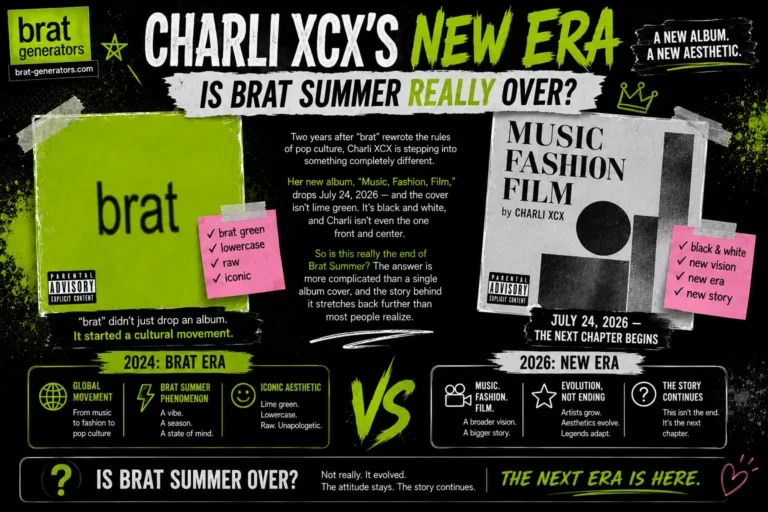
When Charli XCX named her sixth studio album Brat, she wasn’t just picking a word — she was picking a fight with its old meaning. In an Instagram post around the album’s release, she described the album’s ethos as an unfiltered mix of flaws, mistakes, and ego. She expanded on it further in a TikTok video, describing “brat” as someone a little messy, honest, blunt, and a bit volatile — someone who parties through a breakdown instead of hiding it.
That’s a completely different creature from “an ill-mannered immature person,” which is still how traditional dictionaries define the word. Where the old brat was a problem to be corrected, Charli’s brat is a personality to be celebrated — confident instead of correct, blunt instead of polite, messy instead of put-together.
The shift didn’t stay online for long. By November 2024, Collins Dictionary named “brat” its Word of the Year, officially redefining it as being “characterized by a confident, independent, and hedonistic attitude.” Collins called it a cultural phenomenon that had resonated globally — a rare case of a slang meaning getting fast-tracked into a dictionary’s own top honor within months of appearing.
(Full timeline of how brat summer turned into a global aesthetic — the lime-green wall, the Kamala Harris moment, brat autumn — is covered in detail on our Brat Summer Generator page.)
Why “Brat” Broke a Grammar Rule to Get Here
Here’s the part almost nobody talks about, and it’s genuinely one of the more interesting linguistic side effects of the whole trend.
English usually turns nouns into adjectives with a suffix — sleep becomes sleepy, winter becomes wintry. “Brat” already had its own adjective: bratty (or the rarer “brattish”), meaning “suggestive of a brat.” That word has existed for decades.
But Charli XCX didn’t say “bratty.” She just said “brat” — as a straight adjective, no suffix attached. “She is so brat.” “This song is so brat.” Merriam-Webster’s own language team flagged this directly in a “Words We’re Watching” post, noting that the noun was being used adjectivally without the usual grammatical dressing, and that the internet ran with the pattern almost immediately, applying “brat” to everything from celebrities to household pets.
It’s a small detail, but it’s the kind of thing that separates a word that’s just trending from a word that’s actually changing — and it’s a big part of why linguists, not just pop culture writers, took notice.
From a Word to a Whole Look
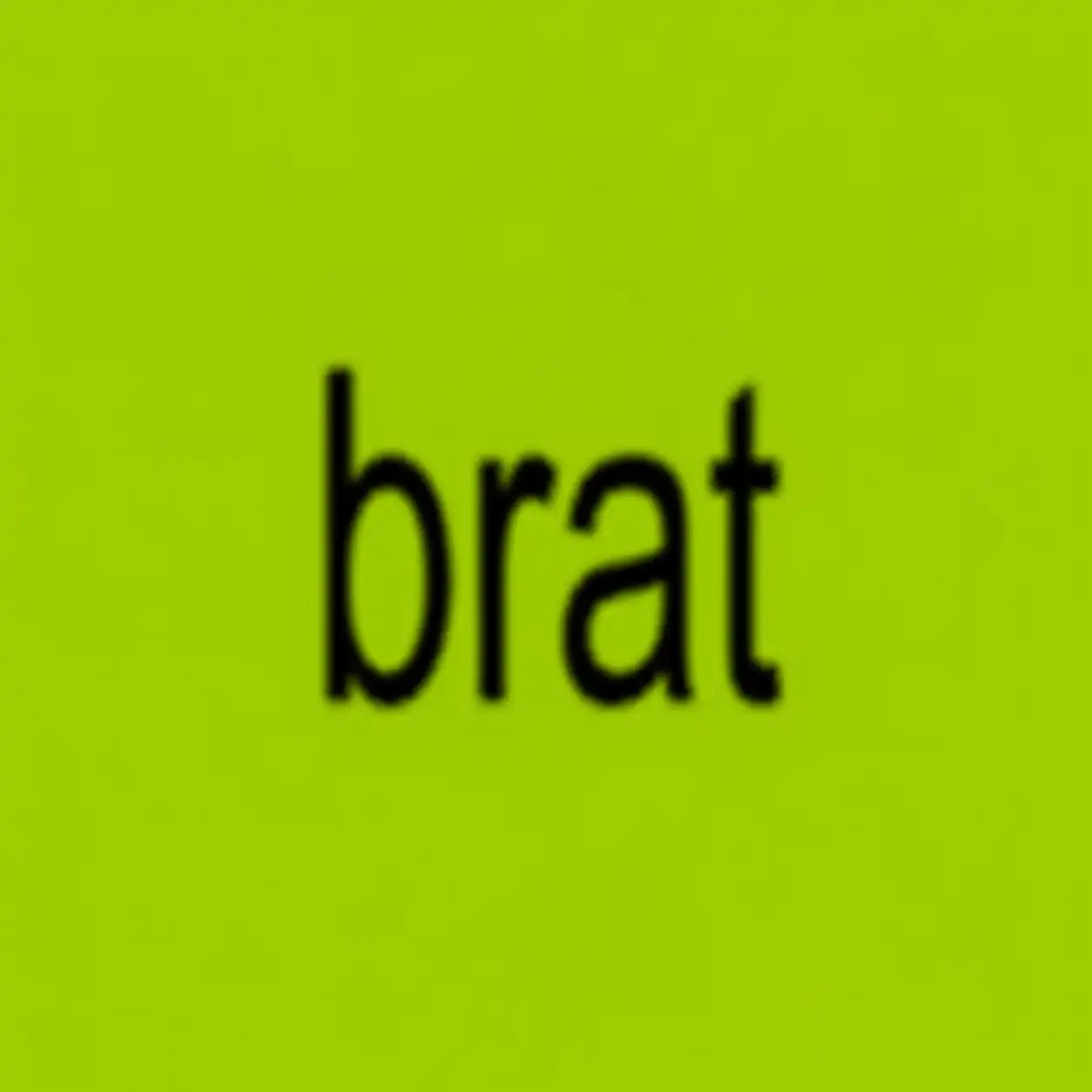
Once “brat” stopped being just an attitude and became something people wanted to wear, it needed a visual identity — and that’s where the album cover comes in. The lowercase, condensed, slightly blurred type treatment against a flat lime-green background became just as recognizable as the word itself, arguably more so. If you’ve ever wondered exactly what typeface that is (spoiler: it’s not a special “brat font,” it’s a stretched, distorted version of a very common typeface), our Brat Font Generator page breaks down the real story.
The green mattered just as much as the type. It wasn’t randomly chosen — it’s part of why the aesthetic reads as loud and confrontational rather than soft, and it’s the reason so many people search for the exact hex code before making anything brat-styled. That color theory (and the exact codes) live over on our Brat Text Generator page.
Put the two together — the type and the color — and you get a visual shorthand that doesn’t need the word “brat” written anywhere to be instantly recognizable. That’s rare. Most trends need a caption. This one just needs a shade of green and a stretched-out lowercase word.
Brat Everywhere: Memes, Politics, and a Whole Season
Once the look existed, it moved fast — faster than most album aesthetics do. It showed up in memes almost immediately (Atlantic Records itself leaned into the meme energy around the album, which is a genuinely unusual move for a major label). It showed up in politics that same July, when Charli XCX posted that Kamala Harris “IS brat,” and the Harris campaign’s online team ran with the aesthetic within days. And it showed up as a full season: “brat summer” became shorthand for an entire mindset, one that Charli herself later extended into “brat autumn.”
Our Brat Meme Generator page goes deeper into how the meme side of this exploded — including the surprisingly official role Atlantic Records played in it, which is one of the stranger and more genuinely differentiated parts of this whole story.
So, What Does “Brat” Actually Mean Today?
Both things are true at once. If you look “brat” up in a traditional dictionary, you’ll still find the old definition sitting right there: an unruly, spoiled child. That meaning hasn’t gone anywhere — ask a parent whose kid is having a meltdown in a grocery store, and they’ll tell you the word still works exactly the way it did in the 1500s.
But say “brat” about a person, a song, or a vibe in 2024 or 2025, and you’re speaking a different dialect entirely — one where the word means confidence without apology, mess without shame, and honesty without a filter. Same five letters. Two completely different jobs.
That’s really the whole story of the word “brat”: a 500-year-old insult that got picked up, dusted off, and handed a new job in the space of a single summer.
Why This Kind of Word Shift Doesn’t Happen Often
It’s worth pausing on how rare this actually is. Plenty of words drift in meaning over decades or centuries — that’s normal language evolution. What’s unusual is a word getting a documented, dated, attributable flip almost overnight, with an actual dictionary tracking the exact moment it happened. Collins didn’t just notice “brat” trending; it formally rewrote the word’s primary definition and handed it a Word of the Year title in the same breath. That’s not something that happens to slang most years — most viral words fade before any dictionary takes them seriously enough to redefine.
Part of why it stuck is that “brat” didn’t need an explanation to spread. A word like “hedonistic” is precise but takes effort. “Brat” did the same job in one syllable, and it came with a built-in visual (the green, the type) that made it shareable without anyone needing to read a definition first. That combination — a word simple enough to say, backed by an image simple enough to remix — is a big part of why it moved as fast as it did, and why so many people now use the tools on this site to recreate that exact look for their own names, captions, and posts.
FAQ
What does “brat” mean in simple words?
Traditionally, “brat” means a badly behaved or spoiled child. Since 2024, thanks to Charli XCX’s album of the same name, it’s also come to mean someone confident, unapologetic, and a little messy — used as a compliment rather than a criticism.
Is “brat” an insult or a compliment now?
Both, depending on context. The original dictionary meaning (an ill-mannered child) is still in use. The newer meaning, popularized by Charli XCX and named Collins Dictionary’s 2024 Word of the Year, is generally used as a positive, self-assured identity.
Who is the “brat singer”?
The “brat singer” refers to Charli XCX, the British pop artist whose sixth studio album, Brat, released in June 2024, sparked the modern meaning of the word.
What’s the difference between “brat” and “bratty”?
“Bratty” is the traditional adjective form of “brat” and has been used for decades to describe brat-like behavior. Charli XCX’s usage skipped that suffix entirely, using “brat” itself as an adjective (e.g., “so brat”), a shift linguists at Merriam-Webster specifically noted as unusual.
Is “brat” also a diet or a movie term?
Yes — “brat” is a completely separate acronym in medicine (the BRAT diet: bananas, rice, applesauce, toast, used for digestive upset) and was also the nickname for a group of 1980s actors known as “the Brat Pack.” Neither is related to the Charli XCX meaning covered in this article.